by Imma Bofill
Architect and Researcher
In the Beginning Was the Word: Genesis of Symbiocene's Architecture.
June 2025
This research proposes an ecological and epistemological shift in architecture
by engaging language as a generative force. It explores symbiosis, AI error, and
multispecies co-creation to imagine new architectural futures.
Ascription to a BecomingThis project aligns with both Becoming More-than-human and Becoming
Attuned. It radically repositions architectural practice as a symbiotic and
perceptive process. Rather than designing from a human-centered viewpoint, it
embraces ecological coexistence through interspecies imagination, coformation,
and linguistic experimentation.At its heart lies the practice of attunement: an openness to listen, perceive, and
respond to other agencies—human, non-human, and machinic. The project’s
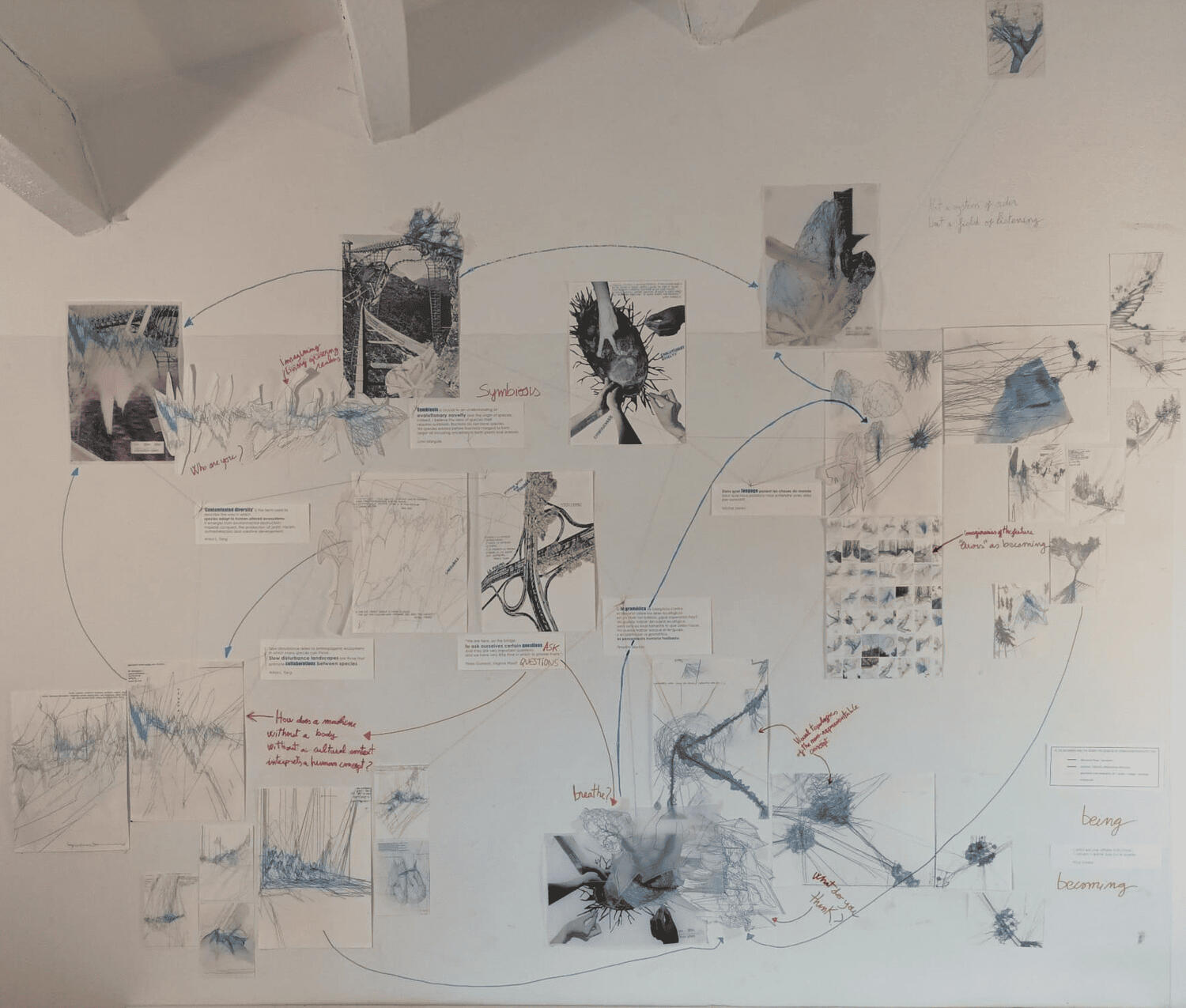
expanded map functions as a living cartography of this attunement. Through
poetic prompts and AI-generated errors, the visual language becomes
unpredictable, hybrid, and emergent.Becoming attuned is both method and ethic here. It involves dwelling within the
uncertainty of relation, allowing language, form, and meaning to arise
collectively rather than being imposed. The architect is no longer a masterbuilder
but a situated listener, a mediator of encounters.By engaging with more-than-human voices and machine learning tools through
an open-ended, embodied, and speculative method, this research proposes
architecture not as product, but as practice: a tuning-in to the complex rhythms
of co-existence.
This research explores how architecture can evolve beyond the Anthropocene
by engaging language as a generative, ecological force.Drawing from Lynn
Margulis’s theory of endosymbiosis and Glenn A. Albrecht’s concept of the
Symbiocene, the project proposes a linguistic and epistemological shift toward
architectural thinking grounded in symbiosis, multi-species collaboration, and
ecological co-habitation.To build an architecture that fosters eco-homeostasis, we ask, with Michel
Serres: “Dans quel langage parlent les choses du monde pour que nous
puissions nous entendre avec elles par contrat ?” (Serres, 1990, p. 52). This
question demands a Copernican shift in linguistic habits.The project draws on
Timothy Morton’s “ecological pronoun” (2010) and the speculative narratives of
Ursula K. Le Guin, Donna Haraway, Vinciane Despret, and Anna Tsing,
reimagining the architect as a designer of meaning who no longer speaks about
the world, but with it.Language shapes how we think, influencing perception and possibility
(Boroditsky, 2010). As Tsing (2015) notes, form is the interspecies medium of
connection, where humans and non-humans co-adapt. In this light, architectural
form emerges not from imposition but from encounter, fluid, evolving, and
shaped by many voices, human and beyond.To explore this shift, the project adopts the expanded map as conceptual tool
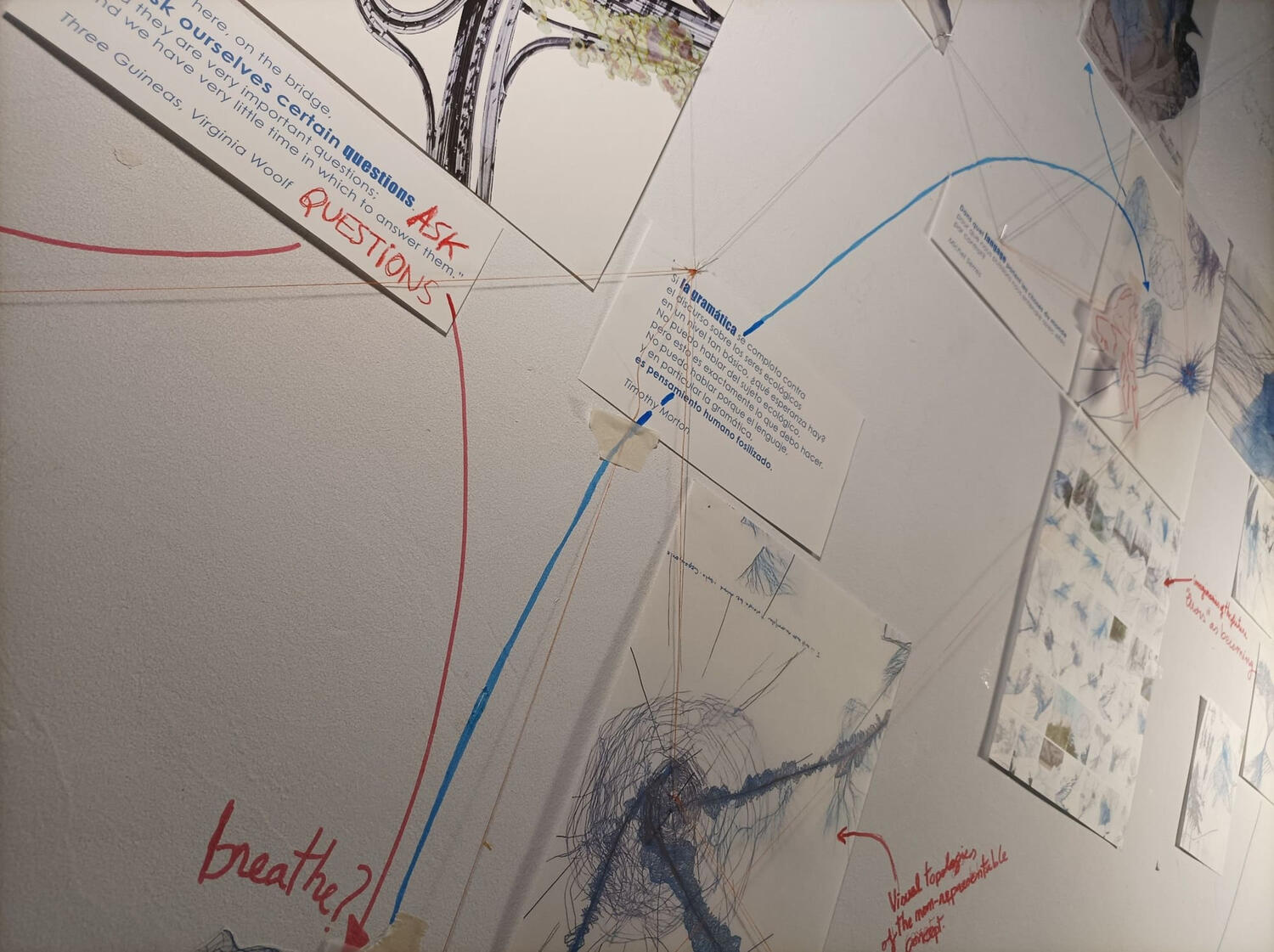
and material artifact. Unlike static drawings, the map is a living cartography, a
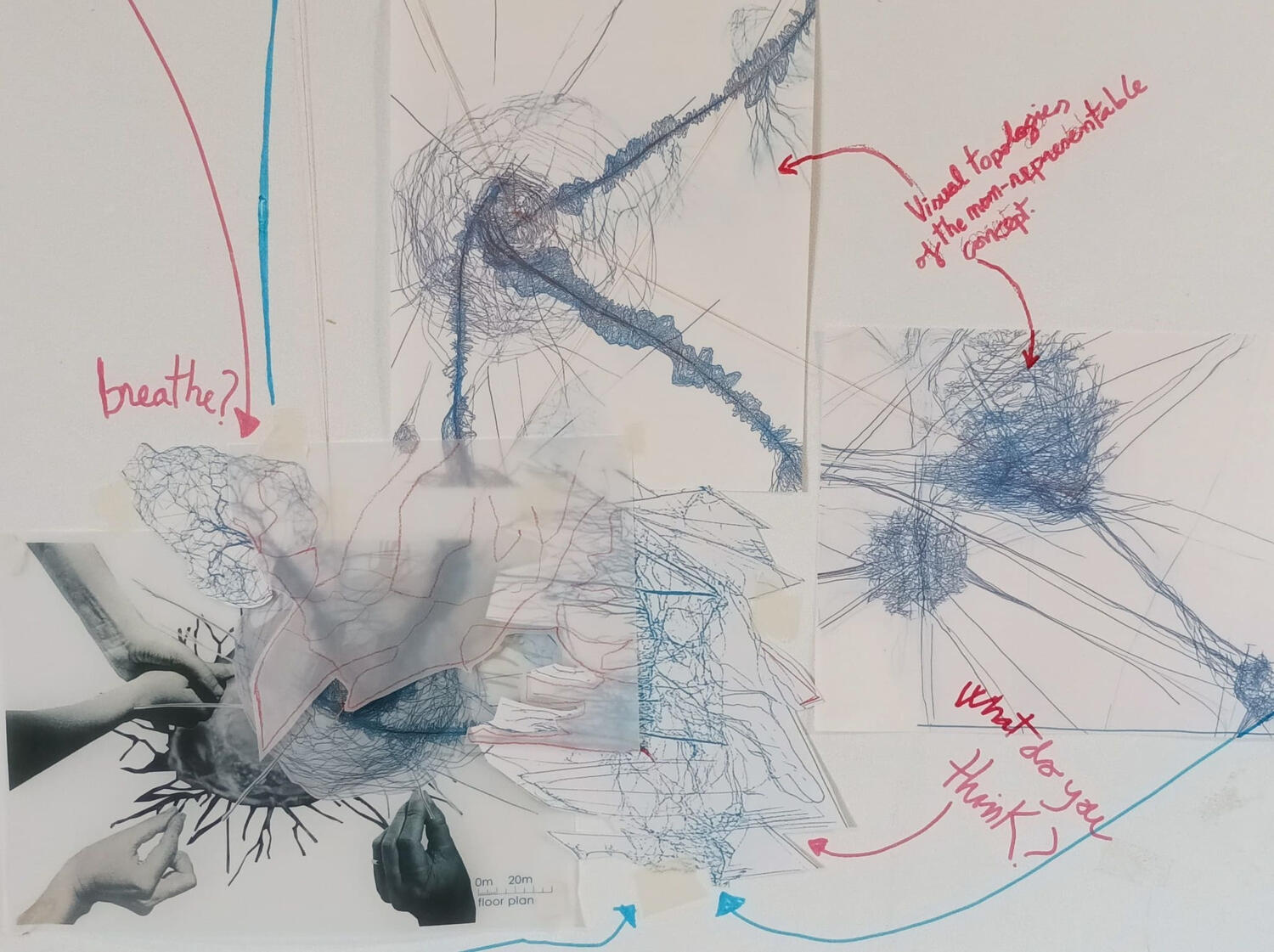
terrain of relations and entanglements. It experiments with AI-generated
images prompted by poetic or conceptual language rather than descriptive
language. These “errors” reveal unexpected architectural potentials.
This resonates with Haraway’s cyborg (1991): a hybrid dissolving boundaries
between human and machine, nature and culture. Here, AI acts as a symbiotic
other.The architect becomes a mediator, composing conditions for emergence
rather than fixed outcomes.
Through layering, writing, and reconfiguring, the map assembles fragments of
fiction, ecological knowledge, and multispecies imaginaries in a sympoietic
composition. Its materiality (translucent paper, threads, pins) evokes coevolution
and becoming.This cartographic artifact does not represent reality but generates space for
other realities to emerge. It proposes architecture as a system of thought that
thinks from within. At the core of this process lies the concept of becoming: not
a goal, but a condition of relation, unpredictability, and co-formation. Becoming
sustains the project’s structure, weaving together the linguistic, material, and
speculative layers into a dynamic field where meanings are not designed, but
negotiated.As Haraway writes: “It matters what thoughts think thoughts; it
matters what stories tell stories.” (2016, p.39).